

In 30 seconds…
GEO isn’t a replacement for brand-building. It’s another reason to get the fundamentals right. Digital PR, SEO, social, creators and community platforms all play a part.
Building a recognisable, credible brand across the places your audience trusts, matters more than chasing individual AI citations.
Five questions can help you decide whether AI visibility deserves more investment - and what that investment should achieve.
As AI adds to how people discover, research and engage with brands, being present in AI-generated answers is only part of the picture.
What matters is what that presence is intended to achieve.
Generative Engine Optimisation (GEO) has become shorthand for improving how brands appear in AI-generated answers. But does that really demand a new approach to marketing? Or is it another reason to get better at the things that have always built strong brands: a clear proposition, credible third-party endorsement and consistent visibility in the places that matter?
Rather than treating GEO as a standalone solution, we’re exploring what brands might actually want from AI visibility, how PR and other channels can contribute, and the questions worth asking before allocating budget.
“Budgets are under more scrutiny than ever, and GEO is often the newest and least defined line on the plan. The brands that get the most from it next year will be the ones that decided what it’s for before they decided what it costs.”
- Natasha Hill, MD & Co-Owner
Ambition isn’t the same as stratgey
There’s no single definition of what success looks like when it comes to GEO. (And who knows if there ever will be an equivalent Google ranking or TikTok virility playbook for LLMs.)
For some brands, the opportunity is to be discovered by new audiences. For some, it’s about making sure their story is understood correctly. And for others, it’s about turning interest into measurable business value.
None of these is new. What’s new is another environment in which brands need to be found, understood and chosen.
Visibility: being found
Your brand appears in relevant AI-generated answers, helping more people discover and consider what you have to offer.
This might be a focus for businesses operating in crowded categories, or those with longer customer research and consideration journeys.
But the opportunity goes beyond AI. Building familiarity and credibility in the publications, communities and conversations your audience already values can pay off across the entire customer journey.
Accuracy: being understood
When your brand appears in AI-generated answers, the information reflects your positioning, products, and pricing correctly.
This might matter for businesses that have gone through a rebrand in recent years, those that have regulated or frequently changing products, or those that have already audited and realised there’s persistent misinformation across LLMs.
Of course, this isn’t just an AI problem. Making sure the market understands who you are, what you stand for and what makes you different has always been central to good comms.
Traffic, leads and sales: Turning attention into value
AI discovery can create new opportunities for website visits, enquiries and sales. But appearing in an answer doesn’t automatically translate into human action.
This might be a priority for businesses already seeing referral traffic from ChatGPT, or established brands looking to turn existing awareness into greater consideration.
It also means thinking beyond clicks. Someone might discover your brand through an AI-generated answer, research you elsewhere and convert later. Not every valuable interaction will appear neatly in a referral report.
New discovery habits. Same brand-building principles
Let’s be explicit, no single channel delivers GEO. And there’s little reason to believe a standalone GEO budget is automatically more valuable than investment in the marketing activities that build brand awareness, trust and authority over time.
Digital PR has an important role here. It helps brands earn attention and credibility in places they don’t own or control. SEO makes useful information easier to discover. Social, creators and communities help brands participate in the conversations that shape opinions.
These channels aren’t interchangeable, and their contribution to AI visibility isn’t guaranteed. But together they can help build the public presence that people - and some AI models - encounter.
So before you plan the channels, it’s worth looking at where your audience’s attention actually goes.
Rand Fishkin, co-founder of SparkToro, has been making this case loudly: the gap between where budgets go and where audiences pay attention is, in his words, “too damn large.”
SparkToro’s illustration of a typical audience makes the point visually. Attention is spread across industry websites, social feeds, YouTube, newsletters, communities and AI tools. Budget, meanwhile, piles into a handful of familiar channels.
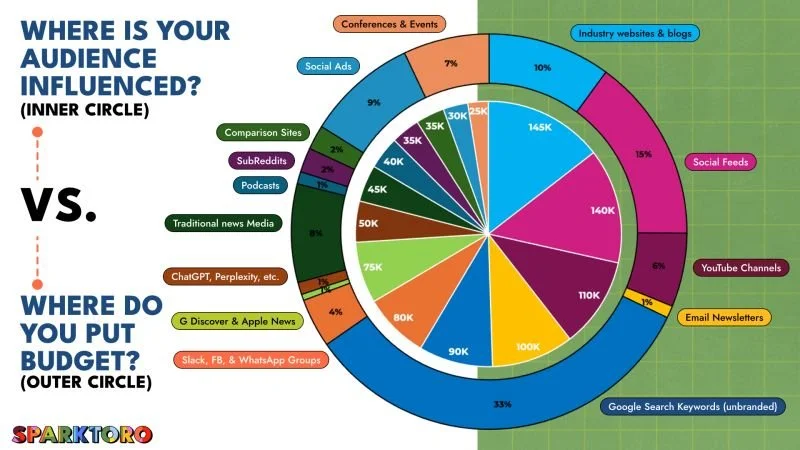
The lesson isn’t that every brand needs to spread its budget across more channels. It’s that investment should follow audience behaviour, not industry hype.
And for brands thinking about AI visibility, there’s an additional consideration: some of the content, coverage and conversations that influence people may also inform the answers LLMs produce.
That’s a compelling reason to strengthen joined-up brand-building, rather than create another disconnected marketing workstream.
For visibility: earn attention in the right places
Digital PR plays a leading role. Relevant earned coverage, expert commentary and original research can help establish a brand’s presence beyond its own channels.
Social and creator content helps brands contribute naturally to current conversations.
Onsite SEO content helps people and search systems find clear, useful answers to relevant questions throughout the research journey.
For accuracy: build a consistent, credible picture
Your own website. It’s the authoritative source of truth you control, so make sure product, pricing and company information is current, present and correct.
Profiles and listings. Business profiles, marketplaces, review platforms and directories should all reflect the same accurate, up-to-date facts.
Digital PR. Clear messaging, informed spokespeople and relevant earned coverage help establish an accurate picture of your business in independent sources.
For traffic: turn interest into meaningful action
Technical SEO. Make your site accessible, useful and easy to navigate, with content that addresses genuine customer questions and purchase considerations.
Useful onsite assets, including original research, tools, calculators and useful resources can give people a compelling reason to visit rather than rely entirely on an AI-generated summary.
Genuine customer reviews , like Trustpilot, alongside case studies and testimonials, can provide reassurance as people evaluate their options.
And measure what matters: not just visits from AI platforms, but engagement, enquiries and commercial outcomes, while recognising the limits of attribution.
“Strong brands are built through clear positioning, consistent communications and credible third-party endorsement. Digital PR has a vital role in that, supported by SEO, social and other channels. AI is changing how people discover brands, but it hasn’t changed why people trust them.”
-Sophie Moore, Strategy Director
Tell one story, everywhere
Perhaps the most important part of preparing for AI-powered discovery is also one of the oldest principles in brand-building: consistency.
Brands become recognisable when people encounter a clear, distinctive story repeatedly, across different contexts and over time.
AI search doesn’t make that principle redundant. If anything, it gives brands another reason to pay attention to how they’re represented across the internet.
Mark Ritson put it simply this summer: AI is powerful, marketing is changing, but “the old rules still apply.” Positioning, differentiation and long-term brand investment don’t stop mattering because the discovery environment has shifted. GEO is worth viewing through that same lens: an evolving place where brands get discovered, not a replacement for established marketing principles.
And consistency doesn’t mean repetition for its own sake. Your website, press coverage, social content and customer reviews should reflect different experiences of the same recognisable brand.
So before the channel plans are written, agree the Single Story:
Three things you want to be known for in your category – distinctive, not generic claims any competitor can make
The proof points behind each one – what makes your story believable?
The language you’ll use consistently
Then make sure every brief carries it: PR, SEO, social, creator partnerships, spokespeople, even the product pages.
The aim isn’t to make every channel say the same thing. It’s to make every channel contribute to the same understanding of your brand.
Five questions to ask yourself
What are we actually trying to achieve? Is the priority greater discoverability, a more accurate representation of the brand or measurable commercial impact? And how does that support the wider business strategy?
What do we want to be known for? Could everyone in the room say it in a sentence? Would our website, coverage and social say the same? And is that positioning distinctive, credible and supported by evidence?
Are we building on the right foundations? Are we already investing in the earned media, brand positioning, content and customer experiences that help people discover and trust us? Where are the genuine gaps, and who is responsible for connecting the activity?
How will we know whether it’s working? Agree realistic measures of progress, establish a baseline and distinguish between visibility metrics and actual business outcomes. Brand-building takes time, and AI citations alone aren’t proof of commercial success.
What are we trading off to fund it? Would that investment strengthen the brand over the long term, even as AI platforms and discovery habits change?
AI is changing how people find information and discover brands. That’s worth understanding, testing and responding to.
But it doesn’t mean the fundamentals of marketing have been rewritten. Building a brand that people recognise, understand and trust still takes time, consistency and credible stories told in the right places.