
The domains your PR plan is ghosting (but LLMs are citing)

In 30 seconds
Strong PR supports strong AI visibility, but it isn’t the whole picture when it comes to outreach content.
For some categories, LLM citations also come from non-editorial sources that are unlikely part of your current target list.
Brands need a visibility strategy that builds attention, authority and accuracy.
So many Marketing Directors we talk to believe something reasonable: strong PR strategy = strong AI visibility. Good coverage, good links, good brand mentions – it all adds up to being well represented when someone asks ChatGPT, Gemini etc who’s best in the category, right?
It’s a fair assumption.
It’s only half right. For some categories, at least.
We’ve recently run commercially-focussed AI visibility audits for a bunch of our clients. Most of them in Financial Services.
And when we looked at the type of sites LLMs are citing when answering best-of questions like:
“Which student bank account should I go for when I start uni?”
“What are the best companies for leasing electric vehicles in the UK?”
“Who provides the best travel insurance cover for over 70s?”
…the sources weren’t dominated by national news, lifestyle blogs or trade publications.
They were comparison sites, directories, industry regulators, government bodies, community forums.
Which raises a question for the folk running a PR-led AI visibility strategy:
What happens to the domains nobody’s pitching to?
The types of domains we didn’t expect to see so many of
In these (client anon) audits, around 60% of the domains cited were non-editorial.
Editorial and news coverage – the places PR is built to win – accounted for around 20%.
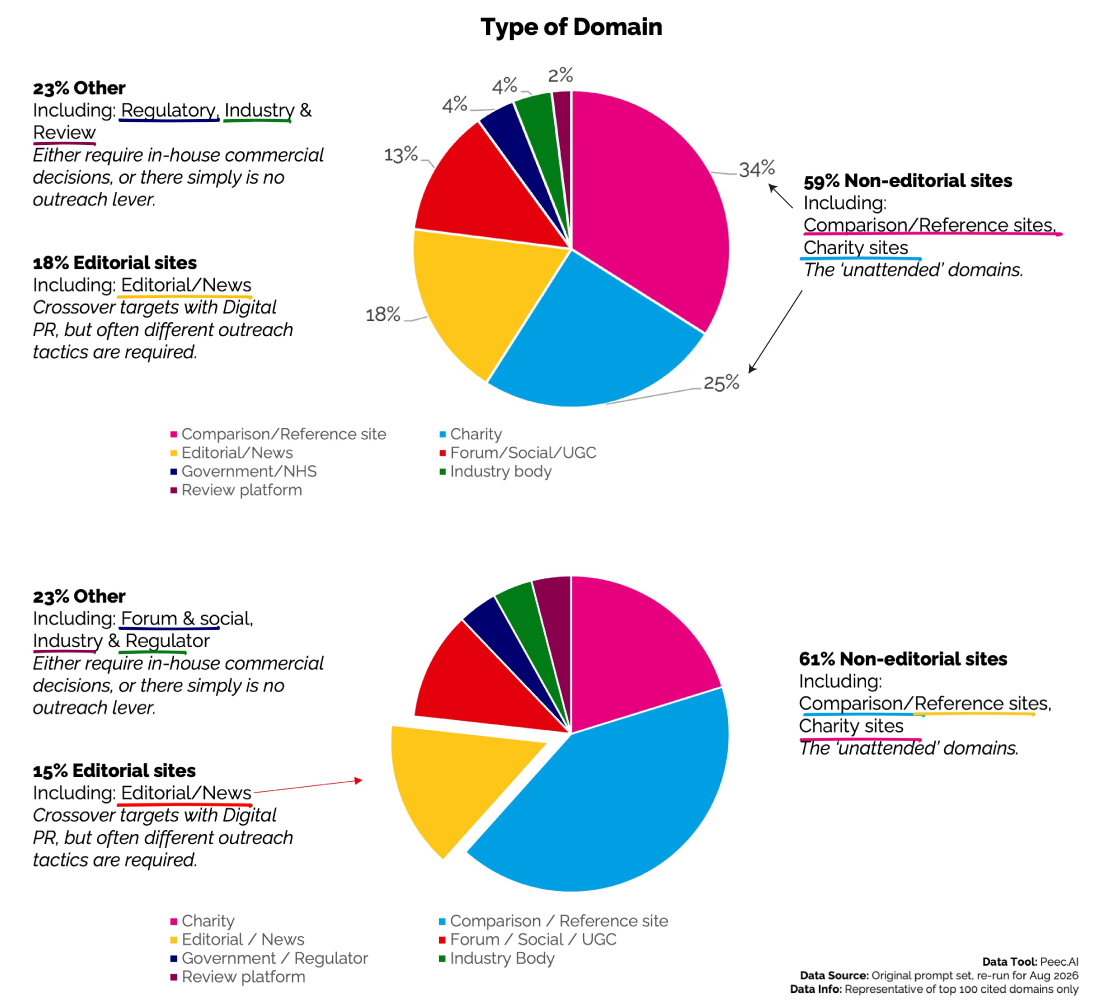
Ok, it’s a small sample. And it’s FS sector heavy. So, we’re not claiming this is a universal law of AI citation behaviour.
But the pattern appeared consistently enough lately, that we took a pause for thought.
Let’s call these non-editorial sites, the unattended domains.
Not because they’re unimportant. Because they’re, more likely than not, rarely included on the account team’s target list.
Yet, unattended domains are the types of sources LLMs are also looking to when they’re trying to get a full, factual picture of a category, a product, a service, a solution.
Nobody’s outreach list is built for unattended domains
Because nobody’s pitching them a story. There isn’t one to tell them.
A comparison site doesn’t need a cultural hook. A directory doesn’t need a case study. A community forum discussion doesn’t need an expert quote.
These sources need content far less glam than a story:
· Your brand name spelled right
· Your positioning described consistently
· Your business attributes up to date
· Your products labelled correctly
· Your pricing accurate
In short, the information that helps a machine answer a commercially-focussed question, with confidence.
In PR terms, this feels almost too basic, too “ugh that sounds like a hygiene job”, to matter.
In AI visibility, it can be the difference between being recommended, misrepresented, or worst-case scenario, ignored 😢
“For years, PRs have focussed on the human-audience-relevant domains that people read. LLMs are forcing us to also pay attention to the domains, and specific URLs, they learn from. For FS brands, we’re increasingly seeing the same types of domains show up. Telling us, the brands in this space that will win in AI discovery, need both editorial and non-editorial in their sights.”
Sophie Moore, Digital Strategy Director
Fame, digital PR and GEO. They’re overlapping, not identical
Here’s the bit worth being explicit about. PR is not irrelevant to AI visibility. Certainly not.
We’re all reading the latest evidence that strong brand authority and earned media presence correlate with greater performance in AI responses. The likes of Hard Numbers and Muck Rack have given us c.80%+ findings to this very point - which is not to be sniffed at.
So this isn’t a case against PR. It’s a case against thinking, and treating, PR as the two-fer solution for your AI visibility strategy.
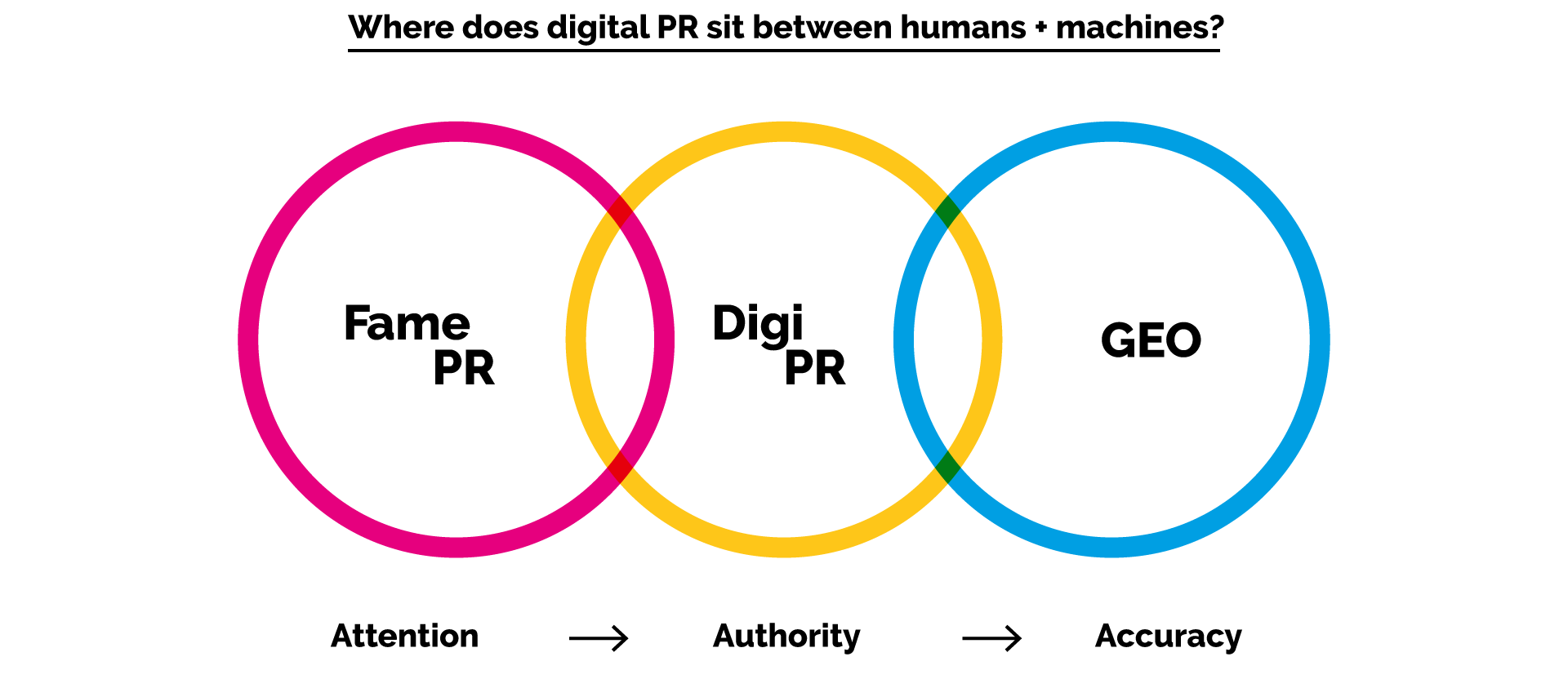
Fame PR stories are designed to earn stop-the-scroll attention.
Digital PR stories are designed to build authority. They’re topically relevant. Original data, reactive commentary, guides are effective at generating newsworthy coverage and building valuable links. Helping reinforce expertise, trust and relevance.
But, neither are designed to help LLMs understand products, services and pricing. Editorial journos would be bored stiff and the chances of securing a decent link are slim.
A useful way to think about this…
Fame PR earns attention.
GEO improves the accuracy of how machines understand you.
Digital PR sits somewhere in the overlap to build authority.
Time to think beyond attention and authority
PR and Marketing teams are already familiar with attention and authority. Measuring Mentions. Links. Reach. Share of Voice.
AI visibility is introducing a third focus; accuracy.
It’s all a bit Jeff Bezos ethos; your brand is how (*replaces people for the internet) describes you when you’re not in the room.
LLMs are building an answer from thousands of external references and trying to determine which facts are most reliable before serving up the answer. If ten high-authority sources (which could absolutely be a mix of editorial and non-editorial) describe your brand proposition one way, and two have outdated summaries, there’s ambiguity.
And ambiguity is rarely good for proper visibility.
A name has been coined for this version of the problem. Kevin Indig of Growth Memo calls it ‘ghost citation’. It’s where an AI model pulls from your content, links to it as a source, but doesn’t actually state your brand name in the answer. Rude.
His research with Semrush, across nearly 4,000 domains, found this happens in around 62% of citations.
Being cited isn’t the same as being seen. And it’s exactly the gap unattended domains help to widen.
How to tackle the ambiguity gap
The problem isn’t a lack of coverage. (Now that would be a whole other conversation between in-house Comms Director and agency-side Client Services Director).
It’s about a lack of maintenance as part of your wider PR plan.
Fix inaccurate information
Strengthen weak messaging
Increase Density by ensuring important info appears consistently
Expand presence into enough influential domains
None of these activities replace digital PR storytelling. They’re complementary. They work to make PR more effective in AI systems.
The question worth asking
The takeaway isn’t that PR has stopped mattering. Far from it.
Strong earned media coverage earns attention, and builds authority. For humans. For Google. And for LLMs.
But if your AI visibility strategy starts and ends with editorial targets, there’s a growing chance you’re optimising for only part of the plan.
Which domains are shaping AI understanding of your category that your marketing plan isn't touching?
Because increasingly, the answer isn't just about the sites everybody wants to be featured on.
It's also about the unattended domains everybody forgot to look at.