Why AI made humans your best PR asset

In 30 seconds
The media are stricter than ever – they want proof a real human is behind the story you’re pitching.
Like Google’s E-E-A-T principles, a journalists gut-check on generic content is testing for real, first-hand, checkable expertise.
The most underused PR asset already exists for all brands: real humans. Many of whom haven’t yet been given a platform, yet.
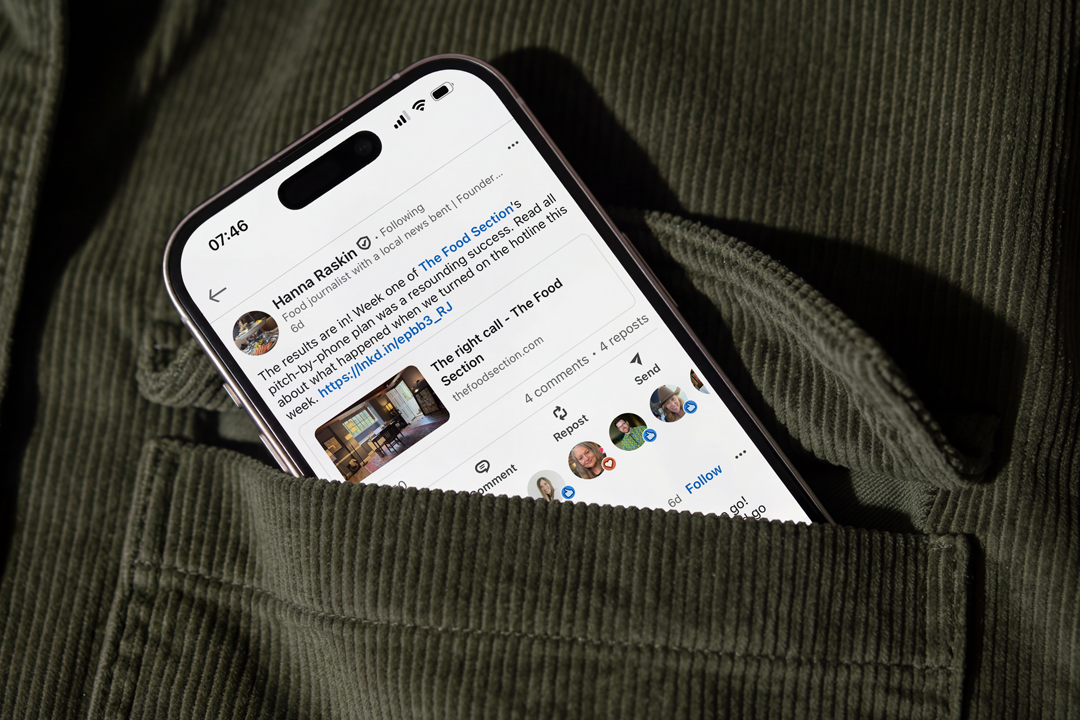
A food publication in the US, The Food Section, just made an announcement that they will only accept PR pitches by phone. No email. Just a hotline.
The founder, Hanna Raskin, didn’t dress the move up either. Her inbox has been, in her words, “deluged” by AI-generated story ideas over the summer, and she’s framed the move as an attempt to re-humanise the PR-to-journo process. With the added bonus, she added, of weeding out anyone not in the habit of actually ringing a stranger.

Old school PRs can be heard rejoicing at this. The newer gen calls it a “step backward”. But is it regression, or, rather a sign of what’s actually coming to our way of working?
Because, when anyone can generate outreach content in a second, the value moves to what’s hardest to generate: real expertise, real experience and a real human willing to put their name to it.
The same filter, further downstream
If journos are getting this kinda sharp-eyed about spotting synthetic efforts on the way in, for sure they’re applying the same instinct to what makes it into their latest story,
A generic quote lifted from a quote bank saved in the PRs files, likely reads the same whether a person typed it or a prompt generated it. Neither survives the scrutiny any better than the other does. And increasingly, the media are asking the same question: is there an actual person behind this, and can I speak to them directly?
This is where Google’s E-E-A-T (Experience, Expertise, Authoritativeness, Trust) principles stop being an SEO footnote and start being a genuinely useful lens on PR.
E-E-A-T was built to separate content with real, lived, first-hand knowledge from content that’s merely competent. And boy did the search engine giant execute a mammoth job of sifting out the crap in its March 2024 Core Update. Reportedly cutting low-quality, unoriginal content in search results by 45%.
That’s the exact same problem a journalist has when 40 pitches land in an hour and most of them could have come from anywhere.
The content that survives both filters tends to share the same characteristics: it’s specific rather than generic, opinionated rather than neutral, grounded in experience rather than hypothesis, and attached to someone who can be challenged on it.

Bottle isn’t alone in reading the situation this way. Kevin Indig, author of Growth Memo, made it one of his name predictions for 2026; as artificial content floods platforms, expect feeds and outputs to start splitting into two lanes – verified human, and everything else.

Likewise, Mordy Oberstein, Head of Brand at SE Ranking, has been running a consistent line through his recent talks on keeping humans at the centre of AI, as the industry reorganises around LLMs.
Neither is talking specifically about PR pitching. But what both are describing is a broader shift in how information gets evaluated.
As AI lowers the cost of producing content, platforms, publishers and audiences become more interested in signals of authenticity. Not because humans are automatically better, but because they provide something AI can’t independently offer; accountability.
The follow-up question is always human
When asking our own Comms team, if they had any examples of journos asking for a real human - even after sharing a press release, a data set, a campaign asset - the Slack channel lit up.
Example 1…
I was speaking to a journalist at a national newsbrand regarding some exclusive data I’d shared for a client story. He came back asking for this:
“We are still interested in covering this data exclusively - thanks for sharing it. But we’re hoping to speak to an expert to help people understand how they can choose the best product too. Is that something you can help with?”
Example 2…
I shared key findings from a recent qual survey with a consumer lifestyle title on behalf of a client. The journo came back with this:
“Instead, do you have real case studies of people who have experienced this to share?”
Different beat, different publications, same ask underneath: not more info, a person to explain it.
Rethinking the modern PR spokesperson
For years, one of the most efficient tools in the PR toolkit has been the quote bank for reactive opps. A set of pre-approved commentary ready to deploy whenever a relevant news story breaks.
It’s fast, it’s reliable. It’s also exactly the kind of asset AI can now replicate.
What LLMs can’t replicate is the conversation that follows. The journos follow-up question. The challenge. The nuance. The experience.
And “the person” isn’t one single job title anymore. There’s a genuine cast, already surrounding your brand, to think through, and appoint spokesperson-type roles.
Senior leaders and founders. The highest natural authority but often the least media trained, and the hardest to get real time with. The investment (and perhaps challenge) is coaching them out of corporate-safe answers.
In-house specialists. The most underused of the lot – real expertise, a real job, a lower profile to build than a CEO but far more scalable (and accessible) across a busy content calendar. We’re talking the Sustainability Lead, the Product Designer, or the Customer Services Manager.
Everyday employee advocates. Different from the specialist buckets – not deep expertise - just real staff, sharing first-hand, day-to-day insight. Delivering authenticity, a single-named spokesperson can’t replicate.
External expert partners. Topically-relevant professionals, academics, third-party specialists. Bought in to lend authority a brand can’t credibly claim about itself.
Customers as case studies. Slower to source, and write-up, than a quote, but among the hardest things for AI-generated content to convincingly fake. A real scenario described by just the person it happened to.
Review and forum voices. Trustpilot, Reddit, Google Reviews aren’t spokespersons, but they are increasingly treated as evidence of real customer experience. They offer a form of social proof that’s difficult to manufacture at scale and worth paying attention to.
Influencers and ambassadors. Their value comes less from reach alone and more from the credibility they’ve built with a specific audience. The strongest partnerships feel additive, not interchangeable.

The proof behind the pitch
Interactive tools and clever campaign formats will always have their place. But the asset that's genuinely underleveraged right now is sitting inside, and around, most brands already.
The real humans.
What journalists are really looking for is someone who can explain the particular issue, defend their perspective, and add something new to the conversation.
That’s not a content asset. That’s a human asset.
“The Food Sections ‘hotline’ feels like an early signal of where things are likely heading. As AI makes content easier to create and outreach to scale, the qualities that become more valuable are judgement, verification and accountability. The media don’t just want information anymore, they want confidence. The brands and agencies that invest in building credible voices, not just generating content, will be the ones that continue to earn attention.”
Cath McElroy – Digital PR & Client Services Director
Oh, and in case you were wondering…
The Food Section’s hotline is already a “resounding success”. Six calls in on day one, and real stories coming out the other end.