

Client: AstraZeneca
How we helped AstraZeneca dominate cell therapy search, from featured snippets to AI Overviews
20,358
total clicks
3.7m+
impressions
97
queries ranking positions 1-3
The Challenge
When AstraZeneca approached Bottle in early 2023, they faced a visibility problem in one of medicine's most rapidly advancing areas: cell therapy. Despite being a major pharmaceutical company with genuine expertise and a growing pipeline, their digital presence didn't reflect their authority.
The cell therapy landscape was intensely competitive. Academic institutions like Mayo Clinic and the NIH dominated search results with comprehensive educational content. Biotech startups were investing heavily in content marketing. And the science itself was evolving at pace: new therapy types, breakthrough clinical trials, and regulatory approvals were changing the conversation every few months.
The situation:
AstraZeneca’s cell therapy page ranked on pages 2-3 for core terms
The page received under 50 monthly clicks
They owned no featured snippets
No brand association existed in the space (“AstraZeneca cell therapy” wasn’t being searched)
Generic content approach meant invisibility to emerging search features
The brief was clear but challenging: establish AstraZeneca as a thought leader in cell therapy, capture visibility for both branded and unbranded searches, and build a content foundation that could adapt as search evolved from traditional links to AI-generated answers.
How we addressed it
Research and strategic foundation
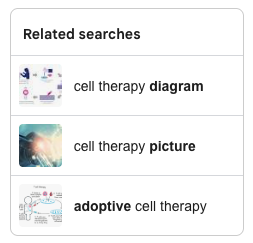
We knew that simply optimising for traditional rankings wouldn't be enough. Search was changing - and changing fast. The emergence of featured snippets, video packs, image carousels, and early signs of AI-powered search meant we needed a content strategy that could perform across multiple SERP features simultaneously.
We began with comprehensive research:
SERP analysis tracked how cell therapy queries were being answered:
Featured snippets dominated informational queries
Video packs appeared for mechanism explanations
Image packs featured diagrams and processes
People Also Ask boxes were expanding to 8-10 questions
Academic sources held top positions.
Competitive intelligence revealed the gap: academic institutions had comprehensive but impenetrable content. Biotech companies offered surface-level explainers. Nobody was bridging scientific rigour with accessibility whilst demonstrating real-world innovation.
Content gap mapping identified what was missing from AstraZeneca’s page:
No clear content hierarchy for search engine crawlability
No expert attribution (critical for E-E-A-T signals)
No video content (missing video pack opportunities)
No recency signals
Shallow coverage of specific therapy types
No clear demonstration of AstraZeneca’s unique positioning
Content brief development
We developed a comprehensive content brief for AstraZeneca's R&D writing team - not generic SEO recommendations, but detailed strategic guidance.
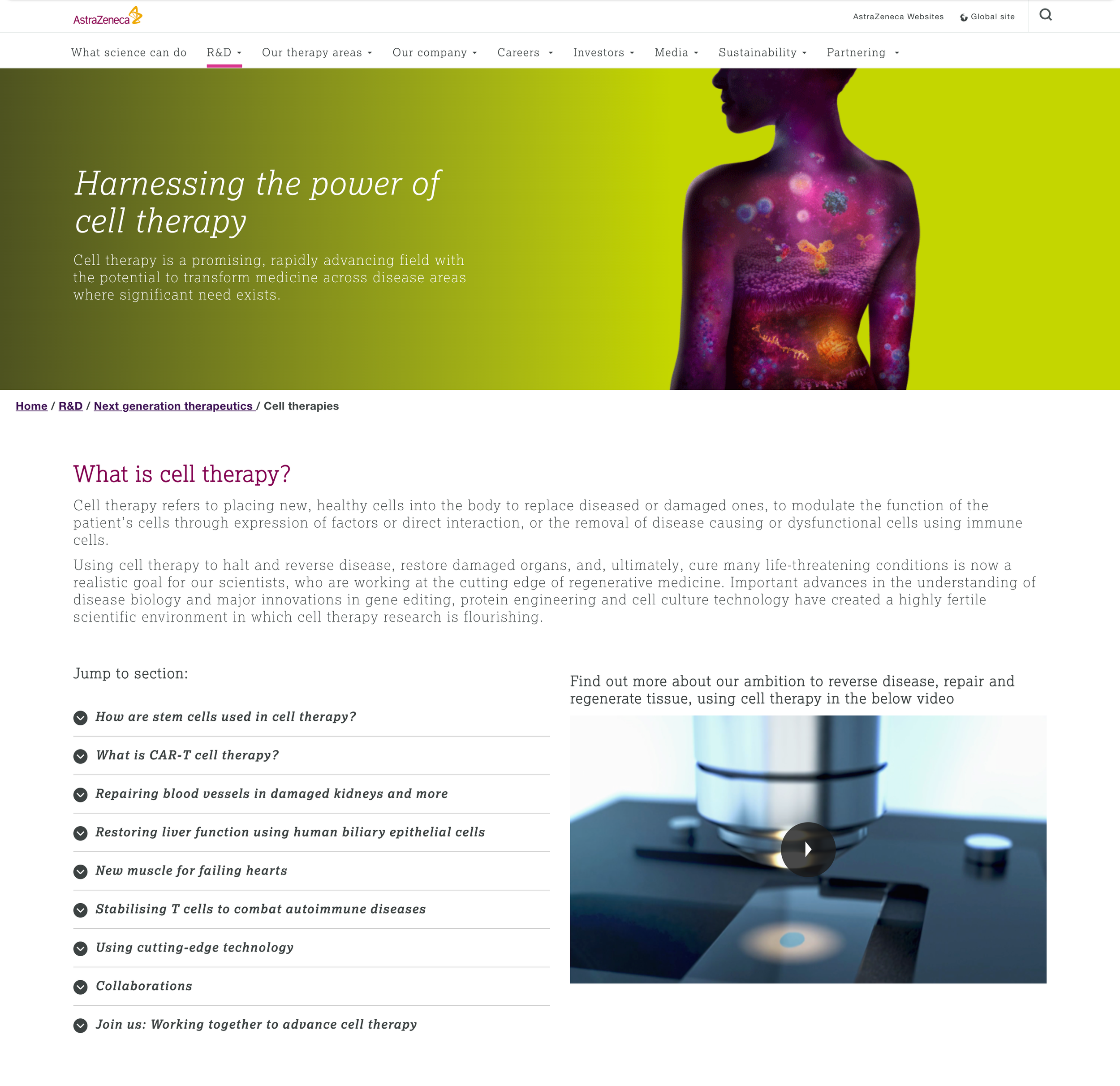
Purpose-driven section architecture: Every H2 had a clear strategic goal:
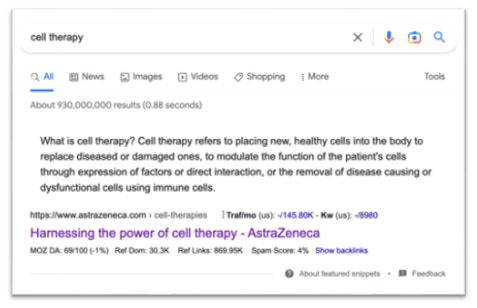
“What is cell therapy?” : capture featured snippets for definitional queries
"Our cell therapy ambition”: establish thought leadership with expert quotes
“Latest updates in cell therapy”: provide recency signals with dated articles
Specific therapy sections: answer expanded PAA queries
Multi-format optimisation
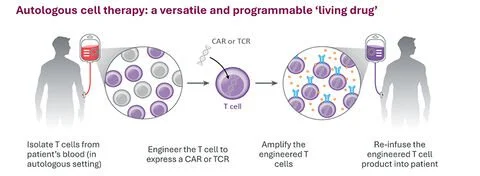
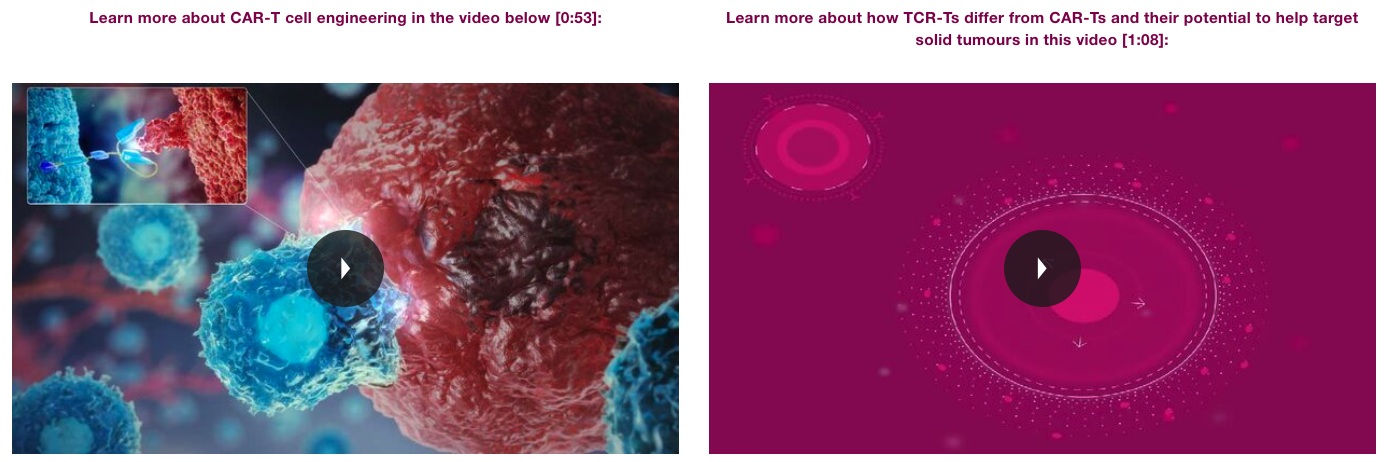
Video integration recommendations for each section
Infographic specifications for image pack performance
Structured data considerations
Jump navidation for improved UX and crawlability
E-E-A-T integration:
Named experts with full credentials (e.g. “Mark Cobbold, SVP R&D Discovery & Cell Therapy Oncology, AstraZeneca”)
Pull quotes that could be extracted by AI systems
References and citations to demonstrate academic rigour
Partnership transparency to show collaborative authority
Internal linking strategy: We mapped both inbound and outbound links to build topical authority, ensuring the cell therapy page sat within a content ecosystem connecting CVRM landing pages, R&D sections, disease area pages, and WSCD articles..
Implementation and iteration
The AstraZeneca team implemented the brief with their characteristic scientific precision. But we didn't stop there. We maintained an ongoing partnership, providing regular SERP monitoring, optimisation briefs as the science evolved, and crucially, adaptation guidance when AI-first search emerged.
When Google began rolling out AI Overviews more broadly in 2025, we recognised this wasn't just another SERP feature - it was a fundamental shift. We guided AstraZeneca through strategic adjustments:
Enhanced content hierarchy for AI extraction
Citation-worthy quotes from named experts
Comprehensive but scannable sections
Multi-modal integration (text + video + image
The results:
Within 2 weeks featured snippet captured for "cell therapy" and related core terms. 20,358 total clicks over nearly 3 years. 3.7 million total impressions. 97 queries ranking positions 1-3. 158 different branded query variations emerged 750 clicks from "astrazeneca cell therapy" at position 1. 40% CTR on top branded queries. 1,000+ unique queries driving traffic. 207 countries reached. 13-position improvement during AI Overview rollout.
Immediate impact: Featured snippet capture (within 2 weeks)
Within two weeks of implementing the first content update, AstraZeneca captured the featured snippet for "cell therapy" and related core terms, immediately boosting visibility above established academic and medical institutions.
Featured snippet queries captured:
“what is cell therapy” 12,028 impressions
“what is cellular therapy” 4,281 impressions
“how does cell therapy work” 481 impressions
“cell therapy definition” 5,263 impressions
These featured positions delivered an average 12.10% click-through rate - more than 10x the 1.15% CTR for unbranded positions 4-10.
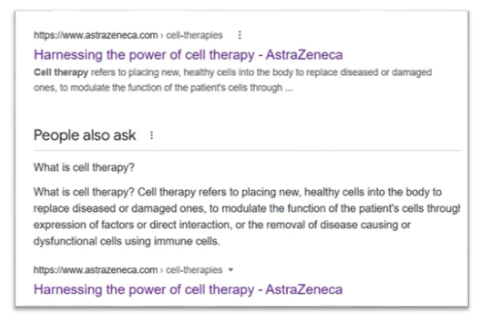
Over two years, AstraZeneca didn't just hold the featured snippet: they expanded their top-three presence across nearly 100 queries. The featured snippet ownership fundamentally changed how AstraZeneca was perceived, positioning them as a recognised authority cited above Mayo Clinic and Wikipedia.
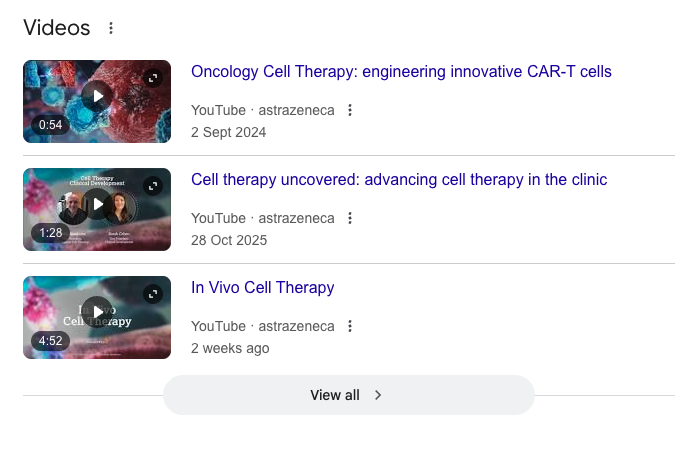
Brand authority established
Perhaps the most telling measure of success wasn't unbranded traffic - it was the emergence of branded searches that didn't exist beforehand.
Pre-partnership (2021-2022): Searches for "astrazeneca cell therapy" were negligible. The brand wasn't associated with the therapy area.
Post-partnership: These weren't people looking for AstraZeneca who happened to be interested in cell therapy. These were people researching cell therapy who now specifically wanted AstraZeneca's perspective. We'd built brand equity in a competitive therapeutic space through search visibility.
Comprehensive topic authority
The strategic content architecture delivered depth and breadth across the entire research journey, from initial "what is" questions to specific pipeline and clinical application queries.
The content strategy delivered unexpected international success across 207 countries, with strong performance in the United States, United Kingdom, India and Canada. In fact, the page ranked in top 3 for queries in multiple languages including French ("thérapie cellulaire" - position 2.08), Russian ("клеточная терапия" - position 2.08), and German ("therapie cellulaire" - position 2.16), demonstrating that high-quality, well-structured English content with proper technical authority can capture international visibility.
The AI Overview Transition
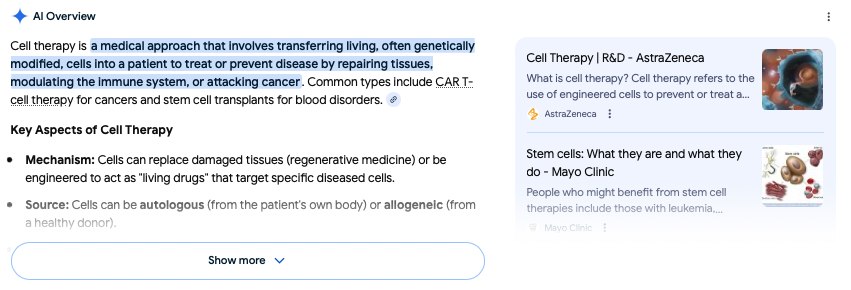
In 2025, Google replaced many featured snippets with AI Overviews, i.e. AI-generated summaries that synthesise multiple sources. This could have been disastrous. Many sites that dominated featured snippets saw visibility collapse.
AstraZeneca's cell therapy page didn't just survive, however- it thrived.
October 2024 baseline:
Average position: 25.43
Daily clicks : 27.1
Daily impressions: 5,069.9
October 2025 (post AI Overview rollout):
Average position: 12.33 (improved by 13 positions)
Daily clicks: 14.0
Daily impressions: 1,993.4 (unfortunately Google’s num=100 update meant inconsistent measurement framework on Search Console)
What this tells us:
AI Overviews directly answer user queries, reducing click-through across all sites. But the 13-position improvement is significant. It indicates that while the featured snippet disappeared, AstraZeneca's content is now:
Cited within AI Overviews as a primary source
Ranking higher in traditional results for queries with AI Overviews
Trusted by Google’s AI systems as authoritative content worth referencing
Strategic significance
Why this approach worked
1. Content architecture for AI extraction
We didn't write for humans or for algorithms; we wrote for both. The content needed to answer questions clearly enough for AI systems to extract and cite, maintain scientific rigour for human readers, and provide clear attribution and expertise signals that AI systems value.
Instead of generic statements, we guided specific, extractable content followed by expert quotes with full credentials. The AI can extract the definition. The human reader gets additional context. Both see the expert attribution.
2. Multi-format content for multi-feature SERPs
We recognised early that ranking #1 wasn't enough. You needed to own the featured snippet, video pack, image pack, People Also Ask boxes, and AI Overviews. Our content briefs specified requirements for each format, ensuring the page could compete across all SERP features simultaneously.
3. Recency without reshuffling core content
One challenge with scientific content is balancing evergreen authority with freshness signals. We solved this through the "Latest updates" section - a dedicated area for dated articles that could be updated regularly without requiring complete page rewrites. This allowed Google to see core content stability whilst acknowledging new developments promptly.
4. E-E-A-T as strategy, not afterthought
Google's emphasis on Experience, Expertise, Authoritativeness, and Trustworthiness isn't a checklist, it's a philosophy. We embedded E-E-A-T throughout:
Experience: Partnership details showing collaboration
Expertise: Named experts with credentials
Authoritativeness: Citations, references and links to peer-reviewed research
Trustworthiness: Transparency about development stages, clear distinction between approved therapies and research
5. Internal linking as topic cluster strategy
We didn't stop at optimising the page - we optimised the content ecosystem. The cell therapy page sits within a network connecting hub pages (CVRM landing, R&D section) and spoke pages (specific therapy mechanisms, disease areas, WSCD articles). This cluster approach tells Google: "AstraZeneca has comprehensive, interconnected expertise across this entire topic area."
Broader implications for technical B2B SEO
First-mover advantage in emerging topics
Cell therapy was (and is) a rapidly evolving field. By establishing authority early, AstraZeneca positioned themselves as the definitive source before the market became saturated.
If your company operates in an emerging space, invest in content authority now, before every competitor copies the playbook.
AI-first content strategy isn't separate from SEO
AI Overviews pull from the same signals that earned featured snippets: clear, answerable content; strong E-E-A-T signals; comprehensive coverage; proper structure. Optimise for one, and you're optimising for both.
Sustained performance requires partnership, not projects
The ongoing partnership meant quarterly check-ins on SERP changes, rapid response when competitors launched new content, strategic guidance when clinical developments required updates, and adaptation when AI Overviews began rolling out. SEO isn't a one-time project in fast-moving fields: it's an ongoing strategic function.
Conclusion
The AstraZeneca cell therapy case study demonstrates what's possible when strategic content architecture meets genuine expertise - and when both parties commit to ongoing partnership rather than one-time optimisation.
From featured snippet capture within two weeks, to sustained dominance over two years, to successful adaptation when AI Overviews replaced traditional SERP features, this page has delivered consistent visibility across multiple search eras.
The results: 20,358 clicks, 3.7 million impressions, 97 queries in positions 1-3, brand association built where none existed, and successful AI Overview transition with a 13-position improvement during rollout.
But beyond the metrics, this proves a vital point: visibility isn't about gaming algorithms, it's about structuring genuine expertise for modern discovery. This is especially important in fast-evolving technical fields. When you do that well, you rank prominently - but you also become the authoritative source that AI systems cite, that competitors benchmark against, and that ultimately, people trust. It’s SEO with strategic content authority.
Looking for a touch of authority?
If your company operates in a technical, fast-moving field and you're ready to establish genuine thought leadership (not just "rank higher"), we'd love to discuss how Bottle can help.
Let’s talk.
hello@wearebottle.com