Brand codes in the age of fragmented discovery: how to build brand recognition now
Originally published 2020. Substantially updated April 2026
In 30 seconds
“Let’s make the logo bigger”. Oof. But (don’t shoot me), that client response is likely a symptom of an asset that doesn’t effectively communicate brand – or a brand that doesn’t understand its own codes.
Brand codes are vital (always have been) but in 2026, when brand discovery is so fragmented, they matter more than ever
But what are they? Are yours working? When even the great Mark Ritson is questioning whether ‘code’ is the right term, what’s the way to build brand distinctiveness now?
By the way, if you want to jump straight to the HOW TO section, it’s here.
There's a version of this page that was written when social media was simpler. When "building a brand on social" meant picking a colour palette for your Instagram grid and getting creative with your mascot.
That world is gone.
Today, a potential customer might first encounter your brand in a TikTok search result. Then see a YouTube Short in their Google Discover feed. Then find a Reel in their Instagram Explore Feed. Then read an AI Overview that references a Reddit thread about your category. Every single one of those moments is a first impression. Every single one needs to work.
This is why the idea of brand codes – i.e., the sensory identifiers that make a brand instantly recognisable, matters more now than ever. The underlying logic hasn't changed. What's changed is the stakes.
What brand codes are, and why even their inventor is rethinking the name
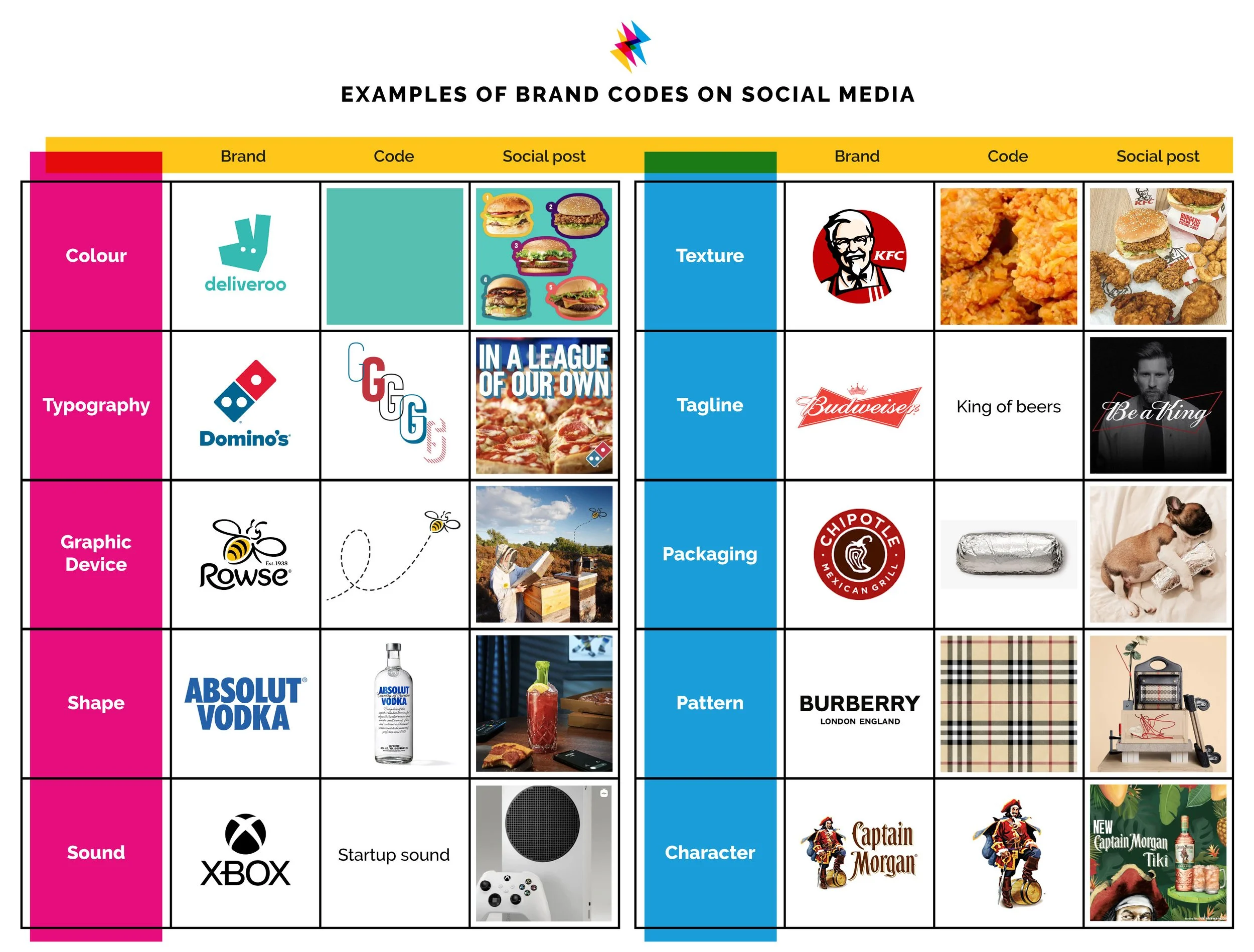
Mark Ritson originated the term "brand codes" while working with LVMH in Paris in the early 2000s, applying it to the likes of Dior and Louis Vuitton. He's taught it to tens of thousands of marketers in his MiniMBA. The gist is: brand codes are the sensory identifiers a brand's customers recognise immediately, before they've consciously registered the logo. Colour. Shape. Texture. Typography. Character. Tagline. Sound.
But in October 2025, Ritson wrote a column in The Drum essentially questioning whether "brand codes" should actually get a rebrand (pun, sorry). Should we instead coalesce instead around "distinctive brand assets" or "fluent devices"? He's even said he'd be willing to retrain 40,000 MiniMBA alumni if a better term won out.
It's a rare thing: the person who popularised a concept publicly reconsidering its own terminology because the discipline deserves more rigour. But the underlying principle is non-negotiable. "First, they must know it's me." Distinctiveness is still the precondition for everything else. If positioning is the soul of a brand, codes are its face and body.
The classic examples are useful to get your head into it: Burberry's tartan. KFC's red and white with fried chicken texture. Absolut's bottle shape. Xbox's startup sound. These are investments in mental availability; the psychological shorthand that allows a brand to be instantly identified across any context, as instinct. Ritson's rule of thumb is no more than five codes (logo plus 2–4 others). Too many and distinctiveness is diluted. Too few and you're invisible.
The critical word is any. When these arguments were first being made, "any context" meant TV, print, outdoor, and a much-younger internet. But in 2026, "any context" includes a 15-second Short, a Google Lens scan, an AI-generated summary, and a discovery feed on someone's phone. The number of contexts where brand codes have to perform has multiplied dramatically, and that changes the urgency considerably.
The fast-influencer era is over. But it already broke how we saw brand.
To understand why this matters now, it's worth taking a look at the last few years – especially on social.
Since about 2015, brands (particularly consumer brands) were encouraged to chase reach. Partner with influencers. Follow TikTok trends. Match the tone of whoever was winning on the platform this month. The implicit logic was that if you showed up where the audience was, in a format they were already consuming, that was enough.
It wasn't, for two reasons.
First, it eroded distinctiveness. Reach without recognition. When every skincare brand used the same soft-focus aesthetic, every DTC brand used the same founder-story format, and every food brand hired the same type of lifestyle creator, they all started to look identical. You might get the impression, but someone else got the credit.
Second (and this is the shift we're living through right now), audiences got wise to it. Partly because we’re kinda having to do it to ourselves too. We make our LinkedIn profiles, our dating profiles, we choose what gets results. Everyone’s an optimisation marketer now.
So, we move on. Take a look at the growth of Substack. What's rising is a preference for voice over volume, perspective over polish, and trust over reach. The macro-influencer era built audiences on aspiration and envy. What's replacing it is built on genuine point of view and earned credibility.
And because they've been shown so bloody much brand content over the last few years, audiences are now incredibly adept at detecting inauthenticity and dismissing it.
Cool cultural observation bro. But what does this mean for you and your brand?
It's becoming clear that the brands that invested in distinctive assets are the ones that survive the trend cycle.
Take TikTok trends for instance. Everyone was obsessed with them in 2021, 2022. Could not breathe on LinkedIn for the posts summarising which brands did the best job of interpreting the trend of the week. The logic was, it's on your audience's algorithm, you want to be front of that algo, yes YES?? Well, copy someone else's idea then.
Except jokes aren't as funny when it's the second time you've heard them. And now the sands of time have worn away our weekly obsessions and actually, when you think about who was really winning on TikTok at that time, it was DuoLingo and Ryanair (no surprise there) BECAUSE they stuck to their own schtick.
My team interviewed Zaria Parvez, the social media coordinator who built Duolingo's TikTok presence during that period, and she put it plainly at the time: their goal wasn't virality for its own sake. It was for Gen Z to watch something and think "wow, that's so Duolingo." Every video leaned on the same asset (did you need me to tell you it’s the Duo owl?) and the same brand personality. They were joining trends, yes, but unmistakably themselves while doing it. And the reason it was unmistakably them was because it was birthed from what they already knew was their identity (or a brand code, if you will): DuoLingo’s push notifications that were a more than a little bit passive aggressive.
You can't build equity on a loan. This has direct implications for strategy. And if you think this just applies to your social media presence, you haven't been listening.
Discovery is now fragmented. Brand codes are the connective tissue.
Your audience doesn't encounter your brand in one place, through one channel, in one format.
Google's AI Overviews now pull from Reddit communities, YouTube, and social platforms. Instagram content from professional accounts is indexed by Google and Bing. YouTube Shorts appear in Google Discover alongside Instagram posts. TikTok has become a search engine, with content being scraped and referenced by AI systems at a rate that increased 321% year-on-year in 2025.
Every one of these touchpoints is a potential first (or fifteenth) encounter with your brand. And the deal with fragmented discovery is, you have basically no control over the order, the context, or the format in which someone first finds you.
What you do have control over is whether you're recognisable when they do.
This is what brand codes (or whichever term we land on) solve. Not because they make things look good, but because they create a consistent signal across inconsistent environments. Add enough of that together and your audience should get a cumulative sense of who you are - even if they've never actively sought you out.
Without strong brand codes, each of those touchpoints starts from zero. But if you know what you're doing, each one compounds.
How To: Make brand codes that work for you
Audit your codes for all your environments.
Brand codes developed for static print or social media even 5 years ago don't automatically translate. A typographic code that's distinctive in a blog post might be irrelevant in a voice search result. The exercise isn't just "do we have distinctive assets?" It's "do we have the assets in our arsenal that work to build consistency across a YouTube Shorts frame, a Google Lens scan, and an AI-generated summary?"
2. Treat every content format as a branding opportunity.
Before you panic, we don’t mean "plonk your logo on the corner of everything”. We mean you need to think multi-dimensionally. When Instagram captions are now indexable by search engines, the text your social team writes is SEO copy, but it's also an opportunity to put brand voice in a new arena. When Shorts appear in Discover feeds, the visual codes in the first frame are doing brand work. When TikTok content feeds AI training data and market intelligence tools, the way your brand solves user problems shapes how AI systems represent you to future searchers. None of this is incidental. All of it is brand.
3. Know that consistency isn't the enemy of creativity.
One of the persistent misunderstandings about brand codes is that they trap creative teams in frustrating boxes of repetition. But that's bull. Constraints enable creativity. Knowing that the thread of a distinctive colour, or character, or texture should consistently appear saves your team from blank-page paralysis. The right codes serve as a prompt for creativity - and ensure that excellent, surprising, memorable work still ladders back to brand recognition.
Consistency doesn't equal boring. It's how you develop personality.
4. Build for recognition, not just for reach.
The metric that matters in fragmented discovery isn't impressions. It's how those impressions build brand recognition. A piece of content that reaches a million people but looks like you’ve copied someone else’s homework might as well not exist from a brand-building perspective. But if it reaches the right people and is unmistakably yours, you're onto a winner. We are so past the era of "spray and pray" on social media targeting. So why are you still making content like we are?
The litmus test for your brand codes
You might have heard this one before (some things don't change). It's a useful exercise for any brand assessing how much their brand codes are working for them.
Take a piece of your recent content and remove the logo or mentions of your brand name. Could someone who knows your brand still identify it?
If the answer is yes, congrats. You’re contributing to your brand's durability. If the answer is no, you're making generic content, even content that your audience loves, but you’re not building a brand.
Thing is, all the content grading tools in the world can't tell you how good you are at being you. You still need a human for that.
In the old, simpler world of social media, this distinction was nice to have. In 2026, it's the difference between wasting money on feeding some billionaire’s algorithm, or actually bringing customers into your world.
"First, they must know it's me." Sounds like the logo obsessive we fear. It's not. In 2026, it's a brand marketer who knows that attention is a start, but qualified attention is worth fighting for.
You don't need to show up absolutely everywhere. You just need to be unmistakably yourself, wherever you appear.
Bottle is an integrated marketing agency that thinks about brand, SEO, social, and PR as interconnected parts of modern discovery — not separate channels. If you're thinking about how your brand codes hold up across the new discovery landscape, we'd love to talk.
PS. Just because we love a little nostalgia trip, here’s our brand code guideline from 2020. Still correct. But we just have a lot more to add now.